
 Image 1 of 1
Advanced - Oil Spill Response (OSR) Supervisors IMO Training Level II
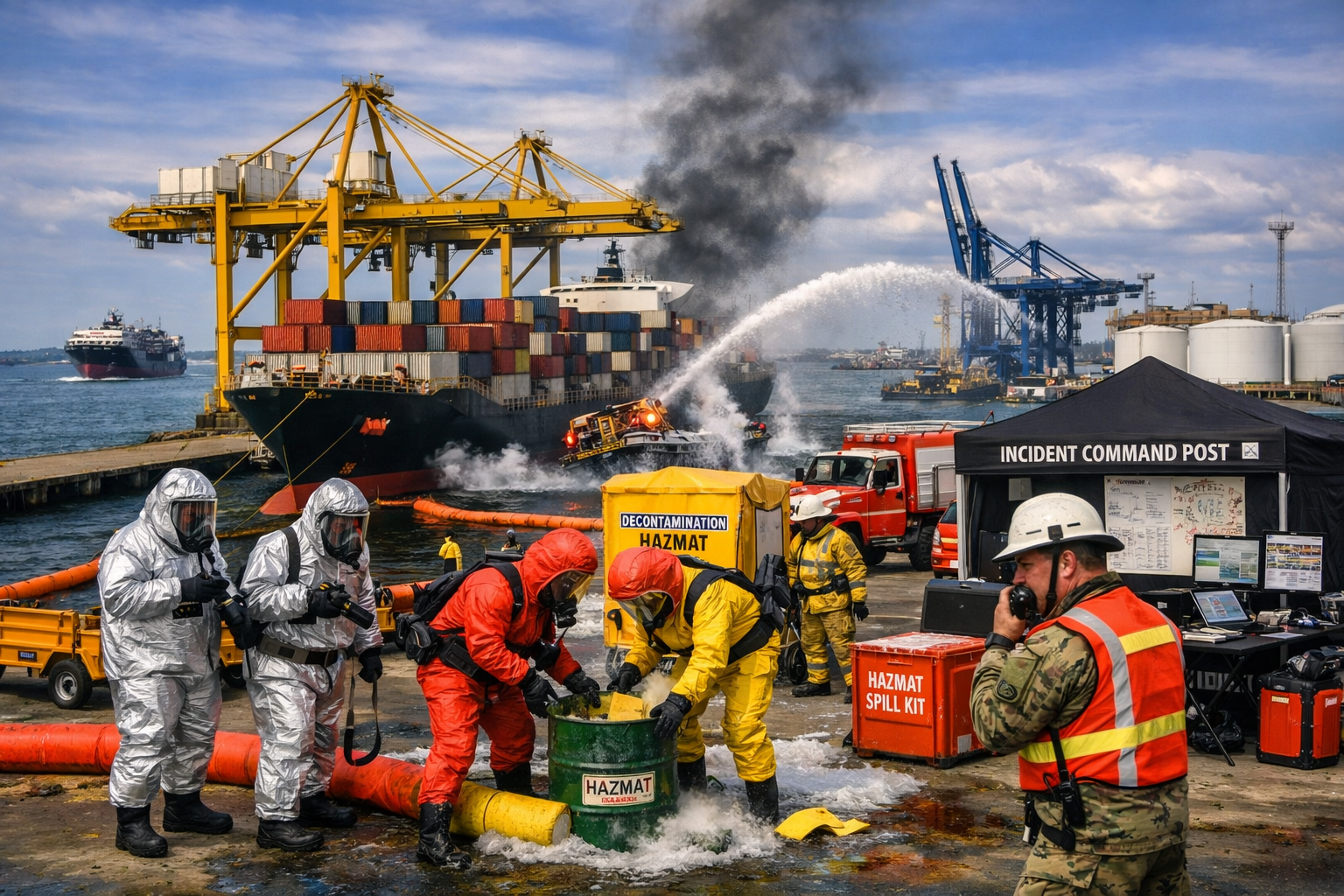
This advanced-level 3-day program prepares port and terminal personnel, incident commanders, emergency planners, and environmental response teams to prevent, manage, and recover from complex environmental emergencies (oil, chemical, and hazardous material releases) in port and terminal environments. Through scenario-driven exercises, specialist modules, and hands-on fieldwork, participants will gain the technical skills, leadership capabilities, and decision-making confidence needed to protect people, property, and sensitive marine and coastal ecosystems.
Who should attend
Senior emergency responders and on-site incident commanders
Port/terminal operations managers and safety officers
Environmental managers and marine pollution officers
Harbor masters, pilots, and tug/supply vessel supervisors
Contractors and spill response team leads
Regulators and government liaison officers engaged in port response
Duration and format
3-day intensive workshop (in-person) with pre-course e-learning and post-course virtual coaching
Optional 2-day exercise extension for full-scale live drills and inter-agency coordination rehearsal
Delivery uses blended learning: instructor-led lectures, tabletop exercises, simulation labs, field deployment drills, and after-action reviews
Learning objectives
By course end, participants will be able to:
Lead unified command and multi-agency responses at ports and terminals under ICS/NIMS principles adapted for maritime settings
Rapidly assess environmental risks and prioritize protection zones for human health, assets, and sensitive habitats
Select and deploy appropriate containment, recovery, and mitigation tactics for oil and chemical spills in complex terminal geometries and tidal conditions
Use modern detection, monitoring, and decision-support tools (remote sensing, UAVs, GIS/plume modeling) to guide response strategy
Implement safe vessel, cargo, and infrastructure response operations, including firefighting interfaces, salvage considerations, and cargo incompatibility management
Develop, test, and refine port-specific emergency response plans and business continuity strategies through realistic exercises
Conduct effective community and stakeholder communication during environmental incidents, including media handling and public advisory coordination
Evaluate environmental sampling and post-incident monitoring protocols to demonstrate regulatory compliance and inform remediation
Core modules
Strategic Command & Crisis Leadership (ICS adaptation)
Unified command structures for port/terminal incidents
Decision cycles, information management, legal/liaison roles
Stress and fatigue management for extended operations
Port-Specific Risk Assessment & Pre-Planning
Vulnerability mapping: terminals, berths, cargo types, sensitive shoreline
Pre-positioning of resources and surge capability planning
Permits, MOUs, and contractual response arrangements
Advanced Containment, Recovery & Mitigation Tactics
Boom deployment techniques for currents, wakes, and constrained waters
Skimming and mechanical recovery under tidal/ice/low-visibility conditions
Use of sorbents, in-situ techniques, and shoreline protection systems
Hazardous Materials & Bulk Cargo Incident Response
Identification of hazardous cargoes and incompatibility matrix application
Response to chemical releases, thermal hazards, and reactive cargo incidents
Interface with firefighting systems and salvage operations
Detection, Monitoring & Modeling Tools
Remote sensing interpretation (satellite, airborne, thermal)
UAV use-cases for situational awareness, plume tracking, and shoreline assessment
Real-time GIS, trajectory modeling, and data fusion for tactical decisions
Environmental Sampling, Forensics & Post-Incident Monitoring
Sampling design, chain-of-custody, and laboratory coordination
Biological and sediment impact assessments
Restoration prioritization and documentation for liability and claims
Inter-Agency Coordination & Legal/Regulatory Frameworks
Roles and responsibilities of port authorities, coast guard, environmental agencies
Legal considerations, reporting obligations, and evidence preservation
International conventions and cross-border response issues
Communications, Community Relations & Media Management
Crafting public advisories and technical briefings for non-technical audiences
Stakeholder mapping and community liaison strategies
Social media monitoring and rapid rumor control
Practical exercises and assessment
Tabletop scenarios escalating to full-scale multi-agency simulation
Live boom deployment and skimmer operations in a controlled marine environment
UAV-based reconnaissance and real-time GIS lab
Hazardous cargo mock breach with firefighting/salvage coordination
Post-incident sampling and evidence handling practical
Individual and team assessments: capability demonstrations, written action plans, and an after-action review with improvement plan
Course prerequisites and entry requirements
Completion of intermediate-level environmental response training or equivalent experience
Familiarity with ICS/NIMS concepts and port operations
Medical clearance for field exercises (where required)
This advanced-level 3-day program prepares port and terminal personnel, incident commanders, emergency planners, and environmental response teams to prevent, manage, and recover from complex environmental emergencies (oil, chemical, and hazardous material releases) in port and terminal environments. Through scenario-driven exercises, specialist modules, and hands-on fieldwork, participants will gain the technical skills, leadership capabilities, and decision-making confidence needed to protect people, property, and sensitive marine and coastal ecosystems.
Who should attend
Senior emergency responders and on-site incident commanders
Port/terminal operations managers and safety officers
Environmental managers and marine pollution officers
Harbor masters, pilots, and tug/supply vessel supervisors
Contractors and spill response team leads
Regulators and government liaison officers engaged in port response
Duration and format
3-day intensive workshop (in-person) with pre-course e-learning and post-course virtual coaching
Optional 2-day exercise extension for full-scale live drills and inter-agency coordination rehearsal
Delivery uses blended learning: instructor-led lectures, tabletop exercises, simulation labs, field deployment drills, and after-action reviews
Learning objectives
By course end, participants will be able to:
Lead unified command and multi-agency responses at ports and terminals under ICS/NIMS principles adapted for maritime settings
Rapidly assess environmental risks and prioritize protection zones for human health, assets, and sensitive habitats
Select and deploy appropriate containment, recovery, and mitigation tactics for oil and chemical spills in complex terminal geometries and tidal conditions
Use modern detection, monitoring, and decision-support tools (remote sensing, UAVs, GIS/plume modeling) to guide response strategy
Implement safe vessel, cargo, and infrastructure response operations, including firefighting interfaces, salvage considerations, and cargo incompatibility management
Develop, test, and refine port-specific emergency response plans and business continuity strategies through realistic exercises
Conduct effective community and stakeholder communication during environmental incidents, including media handling and public advisory coordination
Evaluate environmental sampling and post-incident monitoring protocols to demonstrate regulatory compliance and inform remediation
Core modules
Strategic Command & Crisis Leadership (ICS adaptation)
Unified command structures for port/terminal incidents
Decision cycles, information management, legal/liaison roles
Stress and fatigue management for extended operations
Port-Specific Risk Assessment & Pre-Planning
Vulnerability mapping: terminals, berths, cargo types, sensitive shoreline
Pre-positioning of resources and surge capability planning
Permits, MOUs, and contractual response arrangements
Advanced Containment, Recovery & Mitigation Tactics
Boom deployment techniques for currents, wakes, and constrained waters
Skimming and mechanical recovery under tidal/ice/low-visibility conditions
Use of sorbents, in-situ techniques, and shoreline protection systems
Hazardous Materials & Bulk Cargo Incident Response
Identification of hazardous cargoes and incompatibility matrix application
Response to chemical releases, thermal hazards, and reactive cargo incidents
Interface with firefighting systems and salvage operations
Detection, Monitoring & Modeling Tools
Remote sensing interpretation (satellite, airborne, thermal)
UAV use-cases for situational awareness, plume tracking, and shoreline assessment
Real-time GIS, trajectory modeling, and data fusion for tactical decisions
Environmental Sampling, Forensics & Post-Incident Monitoring
Sampling design, chain-of-custody, and laboratory coordination
Biological and sediment impact assessments
Restoration prioritization and documentation for liability and claims
Inter-Agency Coordination & Legal/Regulatory Frameworks
Roles and responsibilities of port authorities, coast guard, environmental agencies
Legal considerations, reporting obligations, and evidence preservation
International conventions and cross-border response issues
Communications, Community Relations & Media Management
Crafting public advisories and technical briefings for non-technical audiences
Stakeholder mapping and community liaison strategies
Social media monitoring and rapid rumor control
Practical exercises and assessment
Tabletop scenarios escalating to full-scale multi-agency simulation
Live boom deployment and skimmer operations in a controlled marine environment
UAV-based reconnaissance and real-time GIS lab
Hazardous cargo mock breach with firefighting/salvage coordination
Post-incident sampling and evidence handling practical
Individual and team assessments: capability demonstrations, written action plans, and an after-action review with improvement plan
Course prerequisites and entry requirements
Completion of intermediate-level environmental response training or equivalent experience
Familiarity with ICS/NIMS concepts and port operations
Medical clearance for field exercises (where required)